One friend says, “We should have a takoyaki party sometime.”
Sounds good. Takoyaki is great, and doing it at someone’s home is easy.
Then, roughly two weeks later, a completely different friend says the same thing.
Hold on.
Did everyone join a secret takoyaki committee?
Is there an Instagram campaign announcing that October is officially takoyaki-party season? Or does the human brain contain a hidden switch that activates when the temperature drops?
There is no evidence that October is an official nationwide “takopa season.”
But there are surprisingly good reasons why multiple people might independently arrive at the same idea at around the same time.
And once you remember what happens when people grill meat on a hot plate in a sealed room during summer, the mystery becomes much less mysterious.
1. October is not an official takopa month, but there is a funny coincidence
According to an official release from the Nisshin Flour Milling Group, the third Saturday of every month has been registered as “Okopa & Takopa Day” since October 16, 2010.
“Okopa” means an okonomiyaki party, while “takopa” means a takoyaki party.
The key phrase is every month. It is not limited to October.
So there is no official rule saying that Japan collectively enters takoyaki-party mode in October.
Still, the commemorative day itself happened to begin in October 2010.
If two unrelated friends suddenly suggest takopa in October, that coincidence is almost suspiciously perfect.
2. Nobody has to copy anyone for everyone to notice the cooler weather
When unrelated friends suggest the same thing, it is easy to suspect a trend. Social media might play a part.
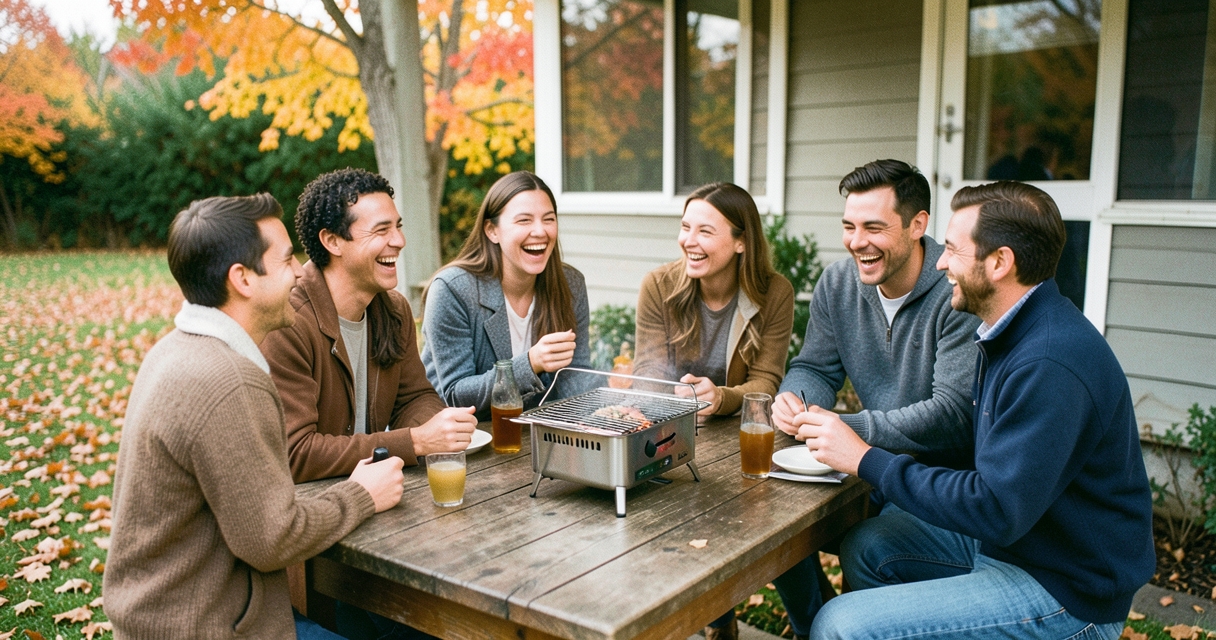
But autumn makes home gatherings easier even without a campaign. You can open a window comfortably, and sitting around a hot plate no longer feels like punishment. If calendars are still quieter than at the end of the year, there is time to get together too.
Perhaps each friend simply thought, “It is finally cool enough to cook something together,” and landed on takoyaki. No secret meeting needed. The weather can send everyone the same message.
3. Summer indoor barbecue can accidentally ship the sauna feature first
Consider the opposite case.
It is summer, and several people are grilling meat indoors.
They do not want smoke and smells spreading into other rooms, so they close the doors.
Outside is hot.
Several human bodies are adding heat.
The hot plate is adding more heat.
Meat keeps cooking.
At some point, the room stops being a dining room and becomes a sauna that nobody ordered.
Imagine joking that a friend’s increasingly comfortable home is turning into a café and that they should install a sauna or a hot-stone spa next.
Then the house delivers only the temperature.
No spa equipment. No wellness program. Just heat.
Eventually, people have to leave the room temporarily between bites because it is too hot.
At that point, the event has become half dinner and half evacuation drill.
4. In autumn, cooking is part of the fun
Once autumn arrives, the problem becomes easier.
A takoyaki plate is still a heat source, of course. But adding heat to a cool room is very different from adding heat to an already hot summer room.
It is also easier to crack a window open.
Compared with indoor yakiniku, takoyaki generally creates a less aggressive combination of oily smoke and lingering smell.
More importantly, takopa combines cooking and entertainment.
Pour the batter.
Turn the pieces.
Fail to make them round.
Watch one person suddenly become a professional.
Listen to another person appoint themselves as supervisor and announce that nobody is allowed to touch a particular piece yet.
The event starts before anyone eats.
Making them gives everyone something to do and talk about.
5. Why “let’s do takopa” works better than “let’s do something”
When you invite friends over, there are a few things to figure out.
What are we going to do?
How long will we stay?
What will we eat?
What happens if conversation slows down?
Takopa solves several of those problems at once.
There is an activity.
It is also the meal.
Everyone can do a small task.
If conversation pauses, everyone can look at the cooking surface.
Mistakes become jokes instead of failures.
No advanced cooking skill is required.
This makes takopa extremely effective for a very common need: people want to meet, but they do not want to design an elaborate event.
Nisshin’s own description of takoyaki emphasized the same basic function: family and friends can gather around the cooking surface, cook together and make the meal more lively.
You do not just eat together. You spend time together while cooking, even while waiting for the next batch.
6. When a home becomes café-like, more event ideas appear
There is another layer.
When a friend’s home gradually becomes more comfortable, stocked with drinks and food, and easy for people to gather in, it starts functioning less like a private room and more like a tiny neighborhood lounge.
Then people stop asking, “Which place should we go to?”
They start asking, “What should we do there next?”
Barbecue.
Hot pot.
Takopa.
Games.
Movies.
The more convenient the location becomes, the more event ideas it attracts.
Once a home acquires the identity of “the place where we cook together,” each new cooking event becomes easier to suggest.
A café-like home eventually grows its own event calendar.
A loyalty card may be only a matter of time.
7. The 2010 survey is useful context, not proof of current behavior
Nisshin Foods also published a 2010 survey of 700 married women in their thirties and forties across seven Japanese cities about home okonomiyaki and takoyaki.
It is useful historical context for understanding household takoyaki culture and its role as a shared meal.
But it is a narrow and old sample.
It cannot prove that young people in 2026 particularly want takopa in October.
The safer conclusion is smaller: cooking takoyaki at home has long been framed as an activity that families and friends can enjoy together.
That helps explain the cultural background.
It does not directly prove the synchronized-takopa phenomenon.
8. Conclusion: maybe the algorithm was just the weather
There is no solid evidence that October is a nationwide takopa season.
But it is not strange for unrelated friends to independently suggest it around the same time.
Summer heat ends.
Hot-plate activities become tolerable again.
Ventilation becomes easier.
Home gatherings become more comfortable.
Shared cooking generates conversation automatically.
Takoyaki is inexpensive, interactive and funny even when it goes wrong.
So multiple people exposed to the same seasonal change can arrive at the same idea.
Synchronized takopa.
Probably not a secret Instagram organization.
Maybe the entire group simply received the same environmental software update:
“Oh, right. It is finally cool enough to sit around a hot plate without dying.”
And if the house already accidentally implemented a sauna during summer barbecue season, autumn deserves an especially warm welcome.
The next upgrade should not be a sauna.
It should be ventilation.
References (2)
- Nisshin Flour Milling Group, “From October 2010, the third Saturday of every month designated ‘Okopa & Takopa Day’,” September 30, 2010
https://www.nisshin.com/company/release/details/100930_570057.html - Nisshin Flour Milling Group, “Second Survey on Household Okonomiyaki and Takoyaki Awareness and Behavior,” September 30, 2010
https://www.nisshin.com/company/release/details/100930_110211.html