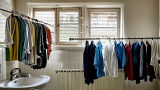
Your bathroom control panel has a "Dry" button. Does it only dry the bathroom? Half right. On a typical Japanese bathroom ventilation dryer (a ceiling unit that ventilates, heats and dries), Dry mode is also used to dry laundry hung inside the bathroom.
So this routine works: wash, hang the clothes in the bathroom, turn on Dry, and the clothes and the bathroom dry together. You no longer need to hang laundry outside, and you worry less about the weather forecast. But it does not mean "no hanging at all." It means "no hanging outside." Hang the clothes on a laundry rod or similar, and leave gaps so air can move between them.
Here is what each mode does. Dry dries clothes and the bathroom. Ventilation pushes humid air out. Heating warms the bathroom. Cool air blows air on models that have it.
So the lazy-person plan is laundry day = Dry, other days = Ventilation. On laundry day, hang clothes that have been spun well and run Dry. On days you do not wash, ventilate after your bath. You are not adding a new chore. You are adding bathroom humidity care to the laundry you already do.
Door open or closed?
During Dry, keep the bathroom window closed. If your door has an air intake vent, close the door and keep the vent open. If there is no vent, some makers tell you to leave the door slightly open, so follow your manual first. The 24-hour ventilation keeps the whole home gently ventilated at low airflow, so do not block the path the fresh air comes in through.
Getting the bathroom back to a dry state quickly helps against humidity and mold. But "Dry button = mold gone forever" is not true. You still need to clean as usual.
How much per run? Is 1.5 hours realistic?
Cost varies a lot by model. In one example, the MAX BS-161H-2, strong drying uses 1,190W. At 31 yen/kWh, that is listed as about 37 yen per hour. Run that example for 1 hour 30 minutes and it comes to about 56 yen per run (37 yen x 1.5 hours).
At 3 times a week, that is about 13 runs a month, or about 730 yen. At 4 times a week, it is about 17 runs, or about 950 yen. Your real cost depends on your rate plan, your model, the mode and the drying time. So it is not "bathroom drying always costs 56 yen." It is an estimate for a 1.19 kW electric unit running 1.5 hours.
In the same MAX example, 24-hour ventilation uses 6W. At 31 yen/kWh, that is about 134 yen per month. So using Dry only on laundry days and 24-hour ventilation the rest of the time is an easy way to split the jobs and the running cost.
Drying time depends on the model, the season, room temperature and humidity, the size of the load, the fabric and how well the clothes were spun. Some makers set the default to 3 hours, so adjust the time by how dry your clothes actually get.
It also helps to put the lid on the bathtub, cut down on dripping water, avoid cramming clothes together, and hang thick items where the air hits them. Packing T-shirts shoulder to shoulder and then complaining "they're not drying!" is like yelling "drive faster!" at a traffic jam on the expressway.
Bottom line: a bathroom dryer does not add chores. It bundles two jobs into one: drying your clothes and not leaving the bathroom damp. For a load that dries in 1.5 hours, the electric example above costs about 56 yen a run. That is not like a trip to the coin laundry every time, and it fits right into your laundry routine.