What the struggle to copy a fly's brain tells us about how strange living things really are
Let's clear this up first: nobody plugged a living fruit fly's brain into a cute 3D anime avatar and turned the fly into a cyber girl. If that had happened, this would be a crime report, not a science story.
1. How it started: "My avatar turned into a fly"
A 3D avatar creator found out that their model was being used as the virtual body for an experiment built on a fruit fly brain model. Their reaction was basically: "I never imagined it would be used like this, lol." The person running the experiment replied, "Sorry for using it in such a weird way," and the creator burst out laughing.
Fair enough. When you make a 3D avatar, you picture it in VR, in screenshots, on livestreams, or getting remixed by fans. "Virtual body for a fruit fly nerve model" is not on that list. Suddenly the avatar's career path leads straight into a lab.
The fun part is that being used at all feels like a reward. It's not just sales or likes. It's proof that your work actually did something useful inside someone else's project. And when the use is totally unexpected, you get a bonus: a follow-up story you could never have written yourself. "My cute avatar is now part of a fly brain experiment" is a rare achievement to unlock.
Of course, not every surprise use is welcome. Fraud, rights violations, damage to the creator's reputation, or unauthorized commercial use would flip the reaction completely. But when the use is harmless, respectful, and technically cool, it can give a piece of work a second life.
2. No, a living fly is not controlling the avatar
You may have noticed a lot of "fly brain hooked up to X" stories lately and wondered if someone is messing with real brains. The key point: no living fly brain is being wired to an avatar in real time.
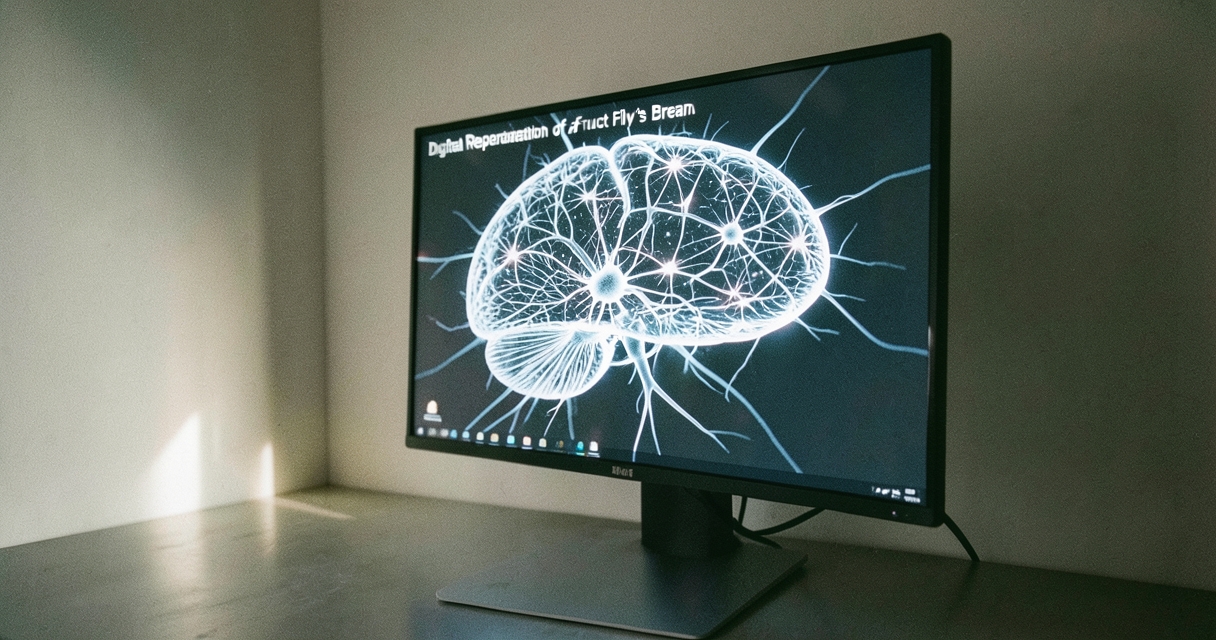
In September 2026, researchers from Google Research, HHMI Janelia, and partner teams released a complete map, down to every single connection point between nerve cells, of the male fruit fly's central nervous system, including the brain and the nerve cord that runs through its body. The map covers 166,691 neurons.
Making it was serious physical work. Real tissue is preserved, sliced into extremely thin layers, photographed with an electron microscope, and then computers rebuild the nerve cells and their links from a huge pile of images. So it starts with a real animal, but what you end up with is a giant digital map of who was connected to whom.
The original fly is not waking up inside a computer asking, "Where am I?"
3. You have the wiring map, but that's not a working brain
This is the most interesting part.
If we've read every connection, can't we just rebuild the network and get a fly? Sadly, it's not that simple.
The map is hugely important, but it mostly tells you about structure. A real nervous system also depends on how strong each connection is, the chemical messengers nerve cells pass to each other and the "docking spots" that receive them, the electrical behavior of cell surfaces, chemicals that tune whole brain areas up or down, which genes are switched on, the brain's ability to rewire itself, support cells, whatever signals are firing right now, and the constant flow of feedback from the senses and the body.
So today's digital brain models use the real wiring but usually describe nerve cell firing with simplified math.
Human: "We mapped the wiring!"
Human: "Great, let's run it!"
Human: "...Why doesn't it act like the real thing?"
Nature: "I just build a new one from an egg every time."
That contrast is brutal.
The problem isn't that the mapping is sloppy. Rebuilding the wiring has become amazingly detailed. The issue is that there's a huge gap between reading the structure and fully replaying what it does.
The wiring map is one important layer of a brain. It isn't the brain itself.
4. So could humans be uploaded someday?
Naturally, the next question is: "Couldn't we do this with people eventually?"
We're actually standing at the starting line already.
In 2024, a team from Google Research and Harvard rebuilt about 1 mm³ (one cubic millimeter) of human brain tissue from the side of the brain at a super-fine scale. That tiny speck alone held about 57,000 cells and roughly 150 million connection points, and the data took up about 1.4 petabytes.
1 mm³ = 1.4 PB.
Brain: "It's just a tiny sample."
Storage: "That is not tiny."
Doing a whole human brain at the same detail would need imaging, storage, computing, and checking on a completely different scale from today. And even with a perfect wiring map, nobody knows whether that alone would bring back a person's personality, memories, or consciousness.
So these are all separate problems:
- reading human brain wiring in high detail
- simulating how a human brain works in high detail
- recreating a specific person's memories and personality
- being able to say "that person's own consciousness" carried on
Sci-fi leaps over all four in a single line. Researchers have to fill in each gap one by one.
5. I came for "AI is amazing" and left thinking "brains are insane"
The harder we try to rebuild nerve circuits, the more ridiculous biology looks.
To rebuild one circuit, humans throw everything at it: electron microscopes, massive storage, machine learning, checking, and people reviewing the results by hand. Meanwhile, living things grow their own nervous system from a single fertilized egg.
And DNA doesn't contain a line-by-line wiring list like "Connect neuron 12,847 to neuron 14,201." Circuits build themselves from a mix of local rules: genes switching on and off, chemical trails, cells nudging each other, nerve fibers being guided to their targets, and fine-tuning based on activity.
Nature didn't just make a finished brain.
It made a system that builds brains, plus a system that changes them through experience.
At that point the surprise flips. It's less "AI is getting close to the brain" and more "wait, what has the brain been casually doing this whole time?"
6. Evolution looks like a giant search where reality itself does the scoring
When you think about how complex life is, evolution starts to look like a huge optimization simulator.
Mutations happen. Creatures live in their environment. The lines that manage to reproduce leave more offspring. More mutations happen. Repeat that over unimaginable stretches of time and numbers of individuals.
In a search program that people design, humans decide how to score the results. In evolution, the real world is the filter: temperature, predators, food, disease, rivals, mates, terrain, and plain luck. The whole thing is one giant exam hall.
But calling evolution "a perfect optimizing AI" would be wrong. Evolution can't see the future. Its goal isn't fixed. Environments change, and past history, chance, and random shifts in genes all play a part.
What evolution makes isn't "the best design in the universe." It's usually something that was good enough to leave offspring in that situation.
That's why bodies are full of patched-on parts and odd detours. Still, when quick fixes keep piling up for hundreds of millions of years, you get nervous systems, immune systems, eyes, flight, and brains that can handle language.
The number of attempts is just absurd.
7. And it's not only living things
Step back from the brain and it gets even wilder.
Cell membranes put themselves together because of how their molecules behave. Plants grow branches by following local growth rules plus hormones and responses to light and gravity. Rivers form tree-shaped networks through a feedback loop: water flows to slightly lower ground, carves it deeper, and that spot collects even more water. Nobody is drawing CAD files for clouds or typhoons either.
You can't explain all of this with natural selection. Landscapes and evolution run on different mechanisms.
But they share one pattern:
Keep running simple local rules and interactions, and huge structures appear with no central command.
People sometimes call this self-organization, or "emergence": big order showing up from many small parts.
It's also fun that blood vessels, tree branches, river systems, and fungal threads sometimes branch in similar ways. They aren't made by the exact same process, but the same limits, like "spread out, gather, and carry things through limited space," keep producing similar shapes.
Nature never holds a design meeting, yet its designs are incredible.
8. Even "eight million gods" would run out of brain space doing it all by hand
At this point, the idea of someone managing every detail starts to sound like the harder option.
Inside a single cell, tons of chemical reactions are running. Cells come together to make a body, bodies join ecosystems, and everything interacts with weather, landscapes, and other species.
Imagine Japan's traditional "eight million gods" approving every single item by hand:
"This cell goes over here now." "Strengthen this connection by 0.3." "Move this raindrop 2 mm to the right." "This branch splits at the next joint."
The meeting to run the universe would never end.
Of course, this isn't an argument that gods don't exist. Theology can define an all-knowing, all-powerful being as something completely different from limited human brainpower.
What we're laughing at here is a model of a human-style central manager blown up to giant size.
Nature's real strength is that it works without signing off on everything at the center. Local rules run side by side everywhere, and the whole picture takes shape as a result. It's one enormous decentralized system.
9. And then the human brain hits its limit
If humans try to hold nature in their heads as it is, it just doesn't fit.
So we compress it.
We give things names. We sort them into groups. We draw diagrams. We write formulas. We build models. We turn messy reality into ideas like "neuron," "gene," "ecosystem," "river," and "weather front," trimming away countless details until it's small enough to carry around.
In a way, science is a really good compression tool for reality.
Of course, compression loses information. A model is not reality. A wiring map is not a brain. A weather map is not the atmosphere. A model of evolution doesn't replay every creature that ever lived.
But if we didn't compress, our short-term memory would give out first.
When we say we "understand" something, it usually doesn't mean we hold every detail of the world in our heads. It means we have an approximation good enough for what we need.
10. Bottom line: No one is in charge, and yet everything runs
This all started from a really weird place: a fruit fly brain model running inside a cute 3D avatar.
But dig in, and it leads to how hard it is to recreate a brain, then to evolution, then to self-organization, then to landscapes, and finally to "the human brain simply can't hold nature's raw data."
The craziest part is that nature doesn't seem to have a site manager looking over everything and giving orders.
A single cell doesn't know it's building a human. A single animal isn't trying to evolve its species. A single drop of water isn't trying to carve a canyon.
Yet small local reactions pile up into brains, forests, rivers, and ecosystems. Then humans with those brains build electron microscopes, read a fly's wiring, and try to make a cute avatar walk with it.
A human brain, made by nature, is analyzing a nervous system that nature spent billions of years building, and trying to build that nervous system again inside a computer that humans made.
That's a lot of layers.
And for now, the strongest takeaway is this:
Nature runs everything with no one in charge. That has to be a bug.