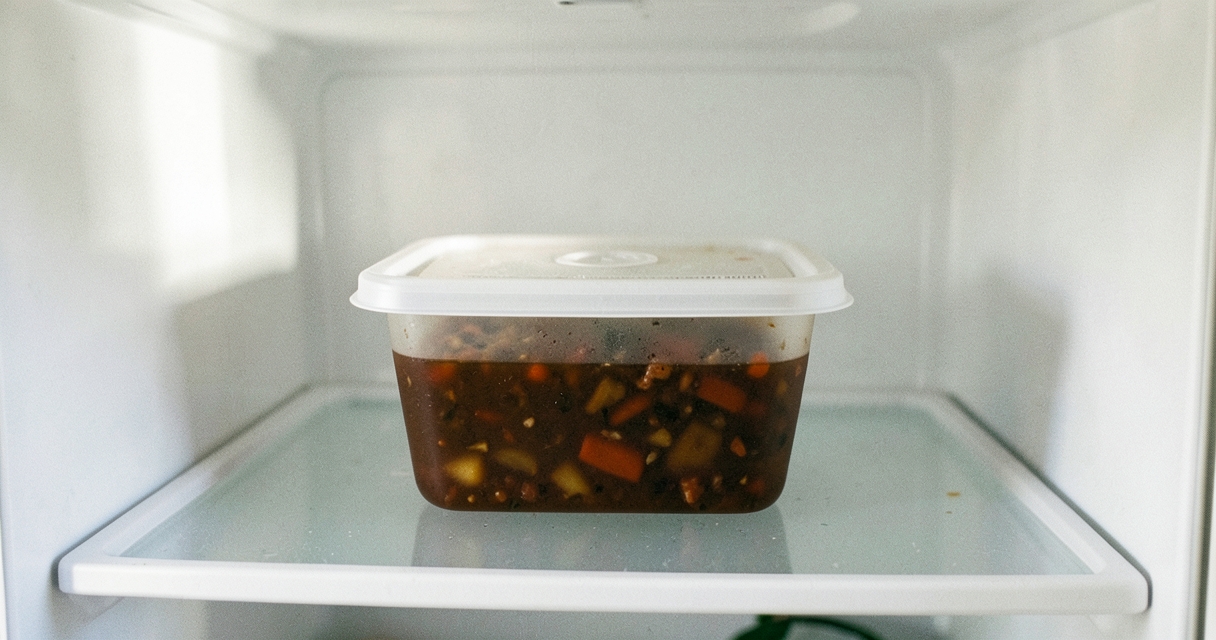
Friday night. You find Sunday’s curry behind the milk. It smells okay. Unfortunately, your nose cannot read a calendar—or detect every foodborne germ.
0. The answer: usually 3–4 days, under the right conditions
USDA guidance is to refrigerate cooked leftovers at 40°F (4°C) or colder and use them within three to four days.[1][2] The Sunday curry discovered on Friday is outside that window.
This is a guideline for food cooled and stored correctly, not a guarantee that everything is safe on day one, two or three. A warm fridge or an overnight stay on the counter can make food unsafe sooner.
1. Why the sniff test cannot clear your dinner
Spoilage sometimes announces itself with bad smells or slime. Foodborne pathogens do not reliably make food smell, taste or look different.[2]
A normal smell is not a safety certificate. And please don't taste a mystery container to find out. Your nose is useful for appreciating curry; it is spectacularly underqualified for microbiology.
2. The clock starts before the fridge door closes
The USDA says perishable cooked food should go into the refrigerator within two hours, or one hour when the surrounding temperature exceeds 90°F (32°C).[1] A deep pot holds heat for ages. Split a big batch among shallow containers so it cools faster.[1][3]
“Let's leave it out until morning so it cools” is not a cooling strategy. It's an invitation to trouble.
3. Don't mix the Japanese and US temperature rules
Japan's health ministry gives 50°F (10°C) or below as a general household-fridge benchmark; the US leftover guidance uses 40°F (4°C) or below.[3][2]
They are not interchangeable promises. Do not use the USDA's three-to-four-day window to justify keeping leftovers for four days at 50°F. Keep a fridge thermometer handy rather than trusting the dial, and avoid cramming containers against every shelf.
4. The forgotten box is not a culinary challenge
If you can't remember when it was cooked or how it was stored, don't ask your sense of smell to reconstruct the crime scene. Throw it out.
Label containers with the cooking date. Put older meals at the front. Freeze portions while they are still being handled safely if you will not eat them soon. The USDA's three-to-four-month freezer suggestion is principally a quality guide, not a way to undo previous unsafe storage.[1]
5. Reheat thoroughly, but don't expect a reset button
The USDA recommends reheating leftovers to 165°F (74°C); Japan's ministry recommends at least 75°C for leftovers.[1][3] Stir microwave meals so the cold center isn't left behind.
Reheating does not reliably rescue food neglected at room temperature or stored for an unknown period.
6. Your future self needs three rules, not a laboratory
Chill promptly in shallow containers. Keep it properly cold and date it. Never use smell as your safety test. The point of meal prep is an easier weekday, not an unplanned stomach-bug experiment.
And if Friday's container feels like an archaeological discovery, treat it like an artifact: admire the mystery briefly, then retire it to the bin.
Health note: Seek medical advice for severe or persistent vomiting, diarrhea, stomach pain or fever; take particular care with young children, older adults and pregnancy.[3]
References (3)
- USDA Food Safety and Inspection Service — “Leftovers and Food Safety fsis.usda.gov
- USDA Food Safety and Inspection Service — “Refrigeration & Food Safety fsis.usda.gov
- 厚生労働省 — 「家庭でできる食中毒予防の6つのポイント」 mhlw.go.jp
